

 Current position > Product detail
『Impeller Flow Meter: Mechanical Rotator Insertion Probes for Large Water Pipes』Related information(clamp on meter|electromagnetic meter|venturi meterrotameter|orifice meter|ultrasonic flow meter|mass flow meter|coriolis mass flow meter|coriolis flow meter|magnetic flow meter|magmeter flow meter|magflow flow meter|mag meter flow meter|electromagnetic flow meter|vortex flow meter|turbine flow meter|thermal mass flow meter|thermal flow meter|rotameter flow meter)
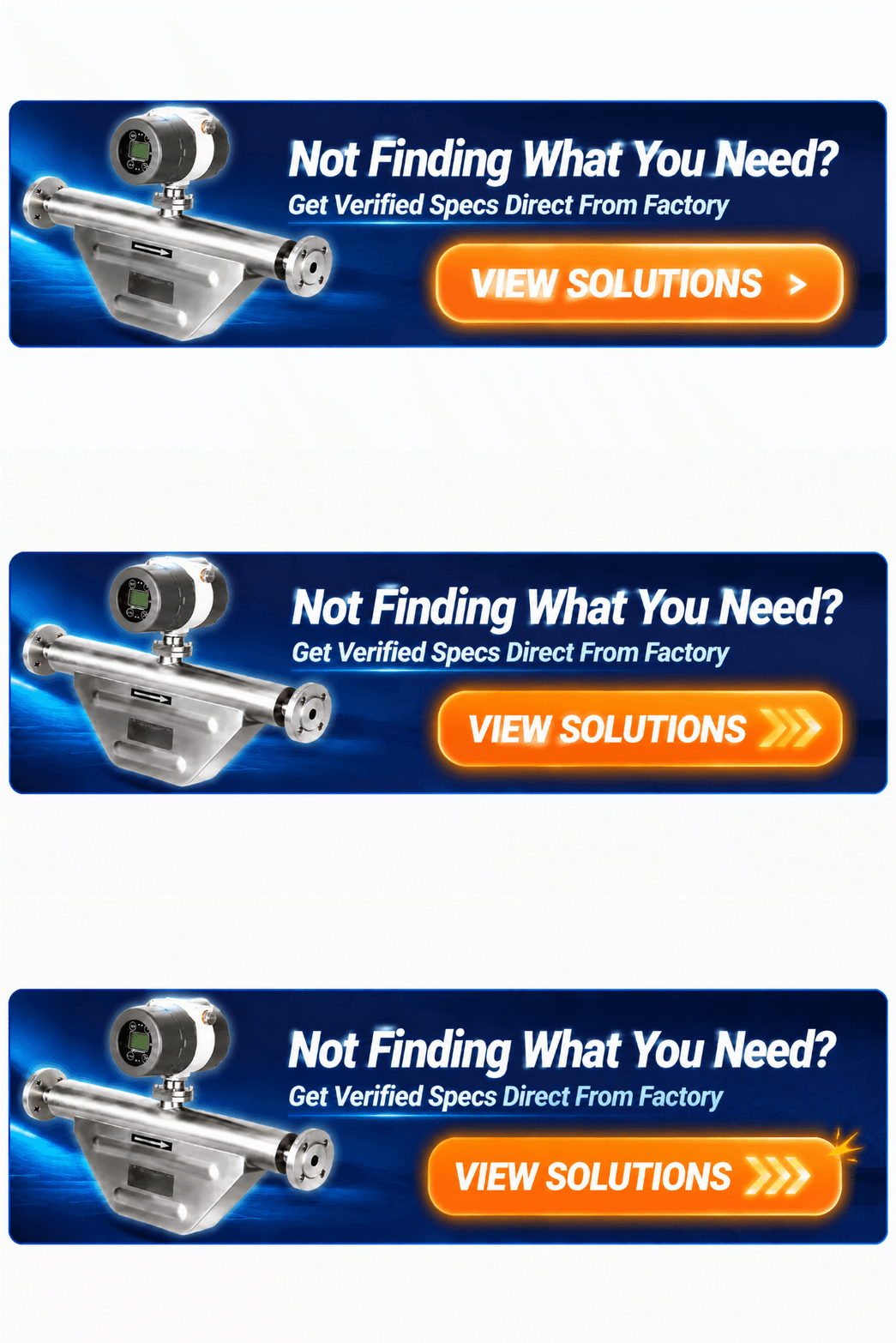
Impeller Flow Meter: Mechanical Rotator Insertion Probes for Large Water Pipes
Quick Answer: An impeller insertion flow meter with a mechanical rotator probe is the most cost-effective way to measure clean water in pipes from DN200 up to DN3000. It gives you a direct local totaliser without needing power, handles 0.5 to 8 m/s flow velocities, and installs through a simple ball valve under pressure. For irrigation, water distribution, or cooling water lines in Southeast Asia, Africa, or the Middle East, this is the flow meter that field teams actually trust.
How an Impeller Insertion Flow Meter Works in Large Pipes
The probe body pushes a small multi-blade impeller into the water stream through a 1.5 inch or 2 inch ball valve. Water flow spins the impeller. A mechanical shaft inside the sealed probe body transfers rotation to a dry dial register at the top. No electronics. No power supply. No PT100 or 4-20 mA HART loops unless you specifically add a reed switch pulse output module. The technology is old and simple, but for large diameter water pipes that is exactly what you want.
One impeller rotation equals a known volume of water. The factory calibrates each probe in a flow rig to map impeller rpm to m/s velocity. Then Silver Instruments prepares the register dial in m3/h or litre units based on your pipe inner diameter. You read the totaliser just like a water utility meter. Because the probe tip only samples flow at a single point inside the pipe, correct insertion depth matters. We supply marked insertion stems and depth calculation tables for every pipe size from DN200 to DN3000.
Why Choose a Mechanical Rotator Probe for Water
Most engineers skip this part, but here is the thing: electromagnetic insertion meters need 220 VAC or 24 VDC, and ultrasonic clamp-on meters fail on old cement-lined or ductile iron pipes with loose scale. A mechanical impeller probe runs on water flow alone. If you have a remote bore pump site in Zambia with no grid power and only a solar panel for a small RTU, this meter still works. You can walk up, read the counter, and record the total volume without ever opening a panel.
Specific benefits we have seen on customer sites many times: - Zero power consumption for the basic local display model - No external earth rings, grounding straps, or lined pipe issues - Works with clean fresh water, groundwater, river water after coarse filtration (mesh > 800 µm) - Temperature range 0 °C to 60 °C, pressure rating PN16 or PN25 depending on probe model - Total cost for a DN800 insertion point including hot-tap ball valve and installation is often under AUD 900 in Australia or USD 600 in Southeast Asia
In practice, water authorities in Thailand and the Philippines choose this probe for bulk raw water lines where high accuracy (±2% of reading above 0.5 m/s) is good enough and the budget does not stretch to a full-bore electromagnetic meter. A 4-20 mA or pulse output option is available if you need to send the flow signal to a PLC or Silver Instruments paperless recorder. But many users just want the mechanical counter.
Where These Insertion Flow Meters Perform Best
The usual applications read like a list of large water pipe projects: - Raw water intake lines at desalination plants in the Middle East (DN600 to DN1200 GRP pipes) - Cooling water supply headers for chemical plants in Indonesia (DN500 carbon steel, 0.6 m/s to 2 m/s) - Irrigation district distribution mains in Australia and Chile (DN300 to DN900 PVC pipes) - Municipal drinking water trunk mains in Nigeria and Ghana (DN400 to DN1000 ductile iron) - Fire water ring main totalisation at refineries and tank farms (DN250 to DN600, NFPA compliance)
We do not recommend this meter for dirty water, wastewater with solids, or slurries. The impeller bearing is a sapphire jewel design that lasts for years in clean water but will jam if fibers or grit enter the probe. For those applications, see our electromagnetic insertion flow meter for wastewater.
Installation Tips for DN200 to DN3000 Pipes
A hot-tap installation under pressure is standard. You weld a 2 inch socket onto the pipe, attach a full-bore ball valve, and then use a hot-tap drilling machine to cut a hole through the valve into the flow stream. After removing the drill, you insert the impeller probe through the valve and lock it at the correct depth. The probe has a compression fitting or flange seal so no water leaks out during or after insertion.
Position the probe where you have at least 10 pipe diameters of straight run upstream and 5 diameters downstream. Avoid placing the probe right after a butterfly valve or elbow. One customer in Vietnam installed the probe only 3 diameters after a 90-degree bend
For vertical pipe runs, install the probe with flow moving upward so the impeller stays wetted and does not trap air. For horizontal pipes, the 3 o-clock or 9 o-clock position is safer than the top of the pipe if air pockets are possible.
Impeller vs Electromagnetic vs Ultrasonic for Water
An insertion electromagnetic meter gives you ±0.5% of rate accuracy and a 4-20 mA signal with empty pipe detection. It is the better choice for billing applications or custody transfer. But it needs power, a converter, and a lined sensor body. A clamp-on ultrasonic meter avoids tapping the pipe altogether, which appeals to water utility managers who cannot shut down a line. But clamp-on ultrasonic does not perform well on porous GRP pipes, thick cement mortar lining, or old cast iron with air inclusions. The mechanical impeller probe is the simplest middle ground: you cut one hole, you install one mechanical meter, and you forget about it for 5 to 7 years with no maintenance except an occasional impeller cleaning.
A Water Utility in Nigeria Cuts Non-Revenue Water
Last year a state water corporation in Nigeria had a problem: their DN900 raw water transmission main from a dam to the treatment plant had no flow measurement. They were losing an estimated 15% of raw water volume to illegal tappings and unknown leaks. We supplied four Silver Instruments mechanical rotator insertion probes with pulse outputs connected to GSM data loggers. The probes cost less than USD 2100 in total. The utility now compares raw water inflow to treated water outflow at the plant daily. Within three months they found and closed three major illegal connections. The payback was less than four weeks just on chemical savings at the treatment plant.
This is a typical case for our mechanical probe: a large pipe, a tight maintenance budget, and a need for simple, reliable totalisation that field crews can read without a laptop.
Request a Quote for Your Large Water Pipe Application
Send us your pipe size (DN), material (steel/ ductile iron/ GRP/ PVC), full-scale flow in m3/h, water temperature, and operating pressure. We will select the correct probe length, impeller material (PPO or PVDF), and register scale for your site. Also tell us if you need a pulse output for remote reading or just a mechanical counter. Our sales team can ship from stock for DN200 to DN2000 probes.
Email: [email protected]
Tel: +86-25-68650347
WhatsApp: +86-25-52155837
WeChat: +86 15365082610
Website: https://flow-meter.com.au
Impeller Insertion Flow Meter FAQ
What is the minimum pipe size for an insertion impeller meter?
DN200 is the practical minimum. Below DN200 the probe body blocks too much of the flow cross-section and accuracy drops. For smaller pipes use an inline turbine flow meter or an oval gear flow meter for clean water batch control.
Can the mechanical probe survive outdoor weather in the tropics?
Yes. The register housing is IP65 rated (dust-tight and rainproof). We have units operating in coastal Thailand and Sri Lanka near the sea with no corrosion issues on the stainless steel stem and nylon-coated register body. Direct sunlight will not damage the mechanical counter but we recommend a small sun shade if the meter is in an open field.
How often do you need to replace the impeller?
With clean water (no sand or silt) the sapphire bearing and PPO impeller last 5 to 8 years of continuous operation. If the water carries fine sand from a bore, you may need an impeller replacement every 2 years. The impeller cartridge is field-replaceable without removing the probe body from the pipe. Remove the retaining ring, pull out the old impeller assembly, insert a new one, and reseal.
Does the meter need recalibration after installation?
The factory calibration factor for your pipe ID and K-factor is set at our flow rig before shipping. As long as you install at the correct insertion depth and follow straight-run recommendations, no field recalibration is necessary. If you ever need to verify, a portable ultrasonic strap-on meter is a practical reference standard.
What output signals are available?
Standard: mechanical 8-digit resettable totaliser and instantaneous flow pointer on the dial.
Optional: dry contact reed switch pulse output (pulse per m3) for PLC, RTU, or paperless recorder input. We can also supply a 4-20 mA output module with a blade sensor and local converter if your SCADA needs an analog signal.