

 Current position > Product detail
『Flow Meter Inline: Standard Direct-Mount Pipe Installation for Process Control』Related information(clamp on meter|electromagnetic meter|venturi meterrotameter|orifice meter|ultrasonic flow meter|mass flow meter|coriolis mass flow meter|coriolis flow meter|magnetic flow meter|magmeter flow meter|magflow flow meter|mag meter flow meter|electromagnetic flow meter|vortex flow meter|turbine flow meter|thermal mass flow meter|thermal flow meter|rotameter flow meter)

Flow Meter Inline: Standard Direct-Mount Pipe Installation for Process Control
Quick Answer: Inline flow meters mount directly into a process pipe, with the meter body becoming a permanent part of the pipeline. This installation method eliminates bypass lines, reduces leak points, and works best when the pipe is full and the flow profile is stable. It is the most common approach for process control in oil & gas, chemical dosing, and food batching because it simplifies maintenance and gives you direct access to 4-20 mA HART or pulse signals at the measurement point.
Many engineers ask us why they should care about the difference between inline and insertion meters. Here is the thing. Inline meters place the entire flow sensor in the process stream. That means all the fluid passes through the primary element. For a magnetic flow meter, the electrodes see the full flow. For a Coriolis meter, the tubes vibrate under the full mass flow. The signal is typically stronger and the accuracy spec is tighter, often ±0.1% of rate for a CNG Coriolis meter in DN15 to DN50 sizes.
Silver Automation Instruments has supplied inline meters to a paint manufacturer in Vietnam, a desalination plant in Saudi Arabia, and a dairy in New Zealand. In each case, the facility needed a compact direct-mount solution without extra upstream or downstream straight run. The paint manufacturer used an oval gear flow meter on a filling line. The desalination plant chose a seawater magnetic flow meter with PTFE liner and titanium electrodes. The dairy installed a hygienic electromagnetic flow meter with Tri-Clamp connections. All three cases show that when you maintain a flooded pipe and match the liner material to the fluid, an inline meter gives repeatable measurements for years.
Why Inline Direct-Mount Installation Wins for Process Control
Process control loops rely on a fast, clean signal. Inline meters deliver that signal right at the measurement point. There is no need for insertion hardware, no thermal well, no extra gasket face. The transmitter sits directly on the sensor body or on a short bracket. A direct-mounted Coriolis meter from Silver Instruments can send mass flow, density, and temperature via a single Modbus RTU or 4-20 mA HART output. The control room gets a live value every 100 ms or faster. That beats a remote mount where long cables can pick up noise in a plant with VFD drives.
In terms of standards, most inline meters follow ISA or ISO requirements for face-to-face dimensions. For example, an electromagnetic flow meter for a DN100 pipe has a standard laying length of 250 mm. This makes it easy to swap out an old meter without cutting new pipe. Our in-house calibration rig in China runs on a master Coriolis reference with 0.05% uncertainty. We test every meter at three or five flow points before shipping, and we include a calibration certificate with the unit.
Direct-Mount Design and Environmental Limits
Direct-mount means the transmitter electronics sit on top of the sensor. This saves wiring time but exposes the transmitter to process temperature and ambient conditions. A typical remote mount can go up to 180 °C on the sensor, but for direct-mount you must check the electronics limit. Most Silver Instruments inline electromagnetic meters keep the electronics at ambient below 60 °C. For hot water or steam condensate above 120 °C, we recommend a remote converter. But the inline sensor stays the same. You just order the meter with a junction box and a separate wall-mount transmitter. When the pipe size is larger than DN200, we sometimes suggest an insertion meter, but that is a topic for another article.
Vibration is a real concern for inline Coriolis meters. If your pipe shakes, the meter tubes can pick up external noise and the density reading drifts. We learned this from a chemical plant in Indonesia that had a pump 1.5 meters upstream with no pulsation dampener. The Coriolis meter output jumped by 2% on every pump stroke. They fixed it by adding a simple support under the pipe and moving the pump check valve. Now the meter holds ±0.15% on a methanol flow of 800 kg/h at 25 °C. Direct-mount installations need proper pipe supports, but they do not need complex straightening vanes if you follow the upstream straight run rule: 5D to 10D upstream for electromagnetic, 0D for oval gear, and as little as 0D for some Coriolis models with built-in flow conditioning.
Matching the Meter Type to the Application
Electromagnetic flow meters (magmeters). Inline magmeters work best for conductive liquids above 5 µS/cm. Water, wastewater, slurries, acids, and caustic solutions. The inline design puts the electrodes in direct contact with the fluid. This gives you a full-bore, obstruction-free path. For a DN50 water line in an Australian cooling tower, we use a compact magmeter with a rubber liner and 316L electrodes. Output is 4-20 mA with HART. The total cost is under AUD 1200 and accuracy is ±0.5% of rate. One customer in the Philippines replaces insertion magmeters every 18 months because of electrode fouling. They switched to an inline meter
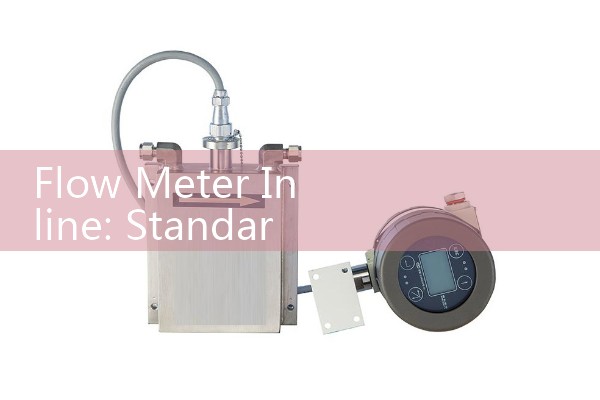
Coriolis mass flow meters. These meters dominate in pharma, food, and high-value chemical batching. An inline Coriolis meter gives you mass flow, not volumetric. When you dose liquid sorbitol at 45 °C, the density changes with temperature. A magnetic meter would need a separate density compensation. A Coriolis meter measures mass directly. We ship a lot of CNG-Series Coriolis meters to dairy processors in New Zealand. They need to measure milk concentrate flow at 85 °C. Direct-mount transmitter works fine because the ambient temp is controlled. The meter body is 316L with a polished surface finish of Ra ≤ 0.8 µm. Accuracy is ±0.1% on mass flow, and the analog output updates every 5 ms.
Oval gear and positive displacement meters. For diesel, lube oil, or solvent, inline oval gear meters give a simple pulse output. A 1-inch meter in a fuel depot in Kenya runs 24/7 with less than 0.5% drift over two years. Direct-mount registration is mechanical or with a small Hall-effect pickup. No external power is needed. This is a robust solution when you just need a local totalizer and a remote pulse for a PLC.
Common Installation Mistakes and How to Avoid Them
Most engineers skip this part, but here is what we see on service calls. First, mounting an inline meter in a half-full drain line. No inline meter works with air slugs. It will either over-range or read zero. The pipe must stay full at all times. Second, ignoring the grounding rings on a magmeter. In plastic pipes, you must use grounding rings or an integral grounding electrode. Otherwise the meter picks up stray voltage and the reading jumps. Last year a customer in Peru called us about a fluctuating signal. We asked one question: “Is the pipe plastic?” It was. They installed grounding rings the next day and the signal stabilized.
Straight pipe runs. For inline electromagnetic meters, we follow ISO 9104. Typically 5D upstream and 3D downstream from any elbow. For oval gear meters, no straight run is needed because the gears chop the flow into discrete volumes. For turbine meters, 10D upstream. Always check the manual. Our test bench shows that reducing elbows cause more swirl than a single 90-degree bend, so double the upstream distance in those cases.
Temperature and pressure limits. A direct-mount inline meter has a pressure rating stamped on the flange. Usually PN16 or PN40 for magmeters. For high-pressure gas, we go up to 100 bar with a turbine meter. Never exceed the flange rating. Similarly, the liner material determines the max temp. PTFE liner handles -40 °C to +180 °C; hard rubber -20 °C to +80 °C. Pick the liner and electrode material based on the chemical. For 30% sulfuric acid, we supply a magmeter with PTFE liner and tantalum electrodes. For seawater, titanium or Hastelloy C.
Silver Instruments Recommended Inline Models for Direct Mount
We stock a range of inline meters with local or remote display. For water and wastewater, the SEMAG series electromagnetic flow meter, sizes DN10 to DN3000, accuracy ±0.5%, 4-20 mA HART, RS485 Modbus, and optional IP68 sensor. For mass flow, the CNG Coriolis series, DN3 to DN150, suitable for 0–120,000 kg/h, accuracy 0.1–0.2%, density and temperature output as standard. For fuel and chemical batching, the SOG oval gear flow meter, 1/4 inch to 2 inch, aluminum or stainless body, pulse output, pressure up to 40 bar. All meters come with a certificate and a 12-month warranty.
To get a specific quote, send your pipe size (DN), fluid name, pressure in bar, temperature in °C, and required flow range to [email protected]. Or call us at +86-25-68650347. For quick questions, use Whatsapp at +86-25-52155837. Our team works with customers in Southeast Asia, the Middle East, Latin America, and Africa. We often ship within 5 working days for standard models.
FAQ
What is the difference between inline and insertion flow meters? An inline meter is installed directly in the pipe with flanges or threaded ends, so the entire flow passes through the measuring element. An insertion meter is mounted through a tap, measuring flow at one point in the cross-section. Inline meters generally offer better accuracy and repeatability for process control because they see the full flow profile.
Can I use a direct-mount transmitter on a high-temperature pipe? Only if the electronics are rated for it. Most standard transmitters accept temperatures up to 60 °C ambient. For fluid temperatures above 120 °C, we recommend a remote converter. The inline sensor remains the same, but you order it with a junction box and separate wall-mount electronics.
Do I need straight pipe runs for all inline meters? No. Electromagnetic meters need 5–10D upstream. Turbine meters need 10D. Oval gear and positive displacement meters need zero straight run. Coriolis meters often have built-in flow conditioning, so 0D is acceptable in many models. Always check the datasheet.
What electrical output should I choose? For most PLC and SCADA s