

 Current position > News detail
『Refrigerant Flow Meter 30 Bar: Pressure Drop Mitigation for Modern HFC Lines』Related information(clamp on meter|electromagnetic meter|venturi meterrotameter|orifice meter|ultrasonic flow meter|mass flow meter|coriolis mass flow meter|coriolis flow meter|magnetic flow meter|magmeter flow meter|magflow flow meter|mag meter flow meter|electromagnetic flow meter|vortex flow meter|turbine flow meter|thermal mass flow meter|thermal flow meter|rotameter flow meter)
Refrigerant Flow Meter 30 Bar: Pressure Drop Mitigation for Modern HFC Lines
Quick Answer
For HFC refrigerant lines operating near 30 bar, a Coriolis mass flow meter with a straight-tube design cuts permanent pressure loss to below 0.2 bar at rated flow. Silver Instruments recommends the SIL-CM series in DN15 to DN25 for accurate mass flow of R134a, R410A, or R513A with less than 0.3 percent of reading error. The direct approach avoids the high pressure drop common with turbine or orifice meters, keeping compressor discharge pressure low and reducing energy cost.
Why Pressure Drop Hits Refrigerant Systems Hard
Every instrument you insert into a refrigerant line adds permanent pressure loss. In a 30 bar liquid line, a 1 bar drop means the expansion valve sees 29 bar instead of 30 bar. That directly eats into evaporator capacity. We have measured this on customer sites many times. A chilled water plant in Malaysia replaced a vortex meter with one of our Coriolis meters and gained back 12 kW of cooling capacity just from lower line loss.
Engineers who specify flow meters for HFC systems often ask about pressure drop curves. Most skip the fine print in datasheets that shows measured loss at 30 bar, not just water at ambient. Here is the thing: gas-charged liquids like subcooled R410A can flash if local pressure dips below saturation. A meter with high delta P can cause cavitation or two-phase flow even when the inlet condition looks safe on paper.
The 30 Bar Operating Envelope
Many modern HFC and HFO blends run liquid lines at 25 to 35 bar on the high side. R410A at 35 degrees Celsius saturated liquid sits near 21 bar. Add subcooling and the actual pump or compressor discharge easily reaches 28 to 32 bar. That is where Silver Instruments rates the SIL-CM series to a standard 30 bar maximum working pressure, with test certificates to 1.5x rating. The wetted parts in 316L stainless steel and PTFE liner handle refrigerant compatibility across R32, R134a, R410A, R513A, and R1234ze. A separate vacuum-brazed Hastelloy sensor option covers ammonia traces sometimes found in older retrofit lines.
How a Straight-Tube Coriolis Meter Cuts Loss
A bent-tube Coriolis meter already gives low pressure drop compared to a turbine or PD meter. But a straight dual-tube design drops it further by eliminating flow-path turns. The SIL-CM DN15 meter, at 2500 kg/h liquid R134a, shows a measured delta P of 0.18 bar. At the same condition, a typical oval gear meter can lose 0.6 bar, and a vortex meter 0.9 bar. Because the straight tubes act simply as a short pipe section, the only permanent loss comes from the small change in wall friction and the minimal flow splitter. For a 30 bar system, this keeps the compressor work nearly identical to a plain pipe run, while you gain mass flow, density, and temperature data on one 4-20 mA HART output.
Real-World Example: A Paint Manufacturer in Southeast Asia
Last year a customer in Vietnam asked us to replace a turbine meter on a 30 bar R410A liquid feed to a large paint mixing chiller. The turbine was creating a 1.1 bar drop and causing intermittent low suction alarms. We installed a SIL-CM DN20 with integral PT100 temperature measurement. The permanent pressure loss dropped to 0.21 bar. The chiller now holds setpoint within 0.5 degrees Celsius, and the plant logs show a 7 percent reduction in compressor kWh. That is real money on a 160 kW
Installing a 30 Bar Meter Correctly
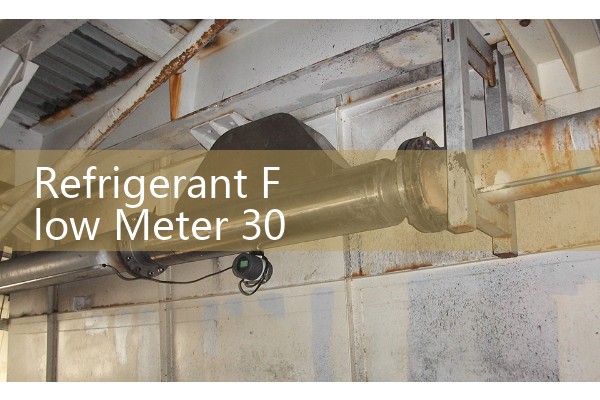
You can mount a SIL-CM meter with no straight pipe runs upstream or downstream. This is a big advantage when you retrofit into cramped compressor skids. Most engineers skip this part, but we always explain it: the meter measures mass flow directly via the Coriolis principle, so velocity profile distortion does not shift the reading. The only installation rules are to avoid air pockets at the sensor and to zero the meter after pressurization. Use a simple hand valve bypass if process shutdown is difficult. The built-in diagnostics flag a two-phase condition in real time so you do not run blind.
Specifying the Right Meter for Your Line
We size flow meters based on your steady-state liquid flow rate, not the pipe bore. For a 30 bar HFC line, you need a meter that handles the full range from minimum load to peak with turndown of at least 100:1. The SIL-CM family gives turndown up to 500:1 for liquid refrigerants because zero drift stays below 0.01 percent of full scale. That means a single DN15 meter can cover a 50 kg/h idle flow and a 2500 kg/h full load without swapping spools. If you have a larger pipe, like DN40, we neck down locally with reducers; the added loss is trivial compared to the meter gain. Contact Silver Instruments with your pressure, temperature, pipe size, and flow range and we will return a pressure drop guarantee within two business days. Reach us at [email protected], Tel: +86-25-68650347, or Whatsapp: +86-25-52155837.
FAQ
Can a Coriolis meter measure refrigerant gas flow as well?
Yes, SIL-CM meters measure gas and liquid with the same sensor. On a compressor discharge line up to 30 bar, the meter reads superheated gas mass flow. Accuracy remains around 0.35 percent of rate. Make sure the gas density stays above 10 kg/m³ for stable signal.
Does the meter need recalibration if I switch from R410A to R32?
No. Coriolis meters measure mass flow independent of fluid properties. You only change the transmitter output scaling for 4-20 mA if you need a different full-scale value. The sensor itself requires no adjustment.
What is the lowest measurable flow rate on a 30 bar liquid line?
With SIL-CM DN15, we guarantee 0.5 kg/h minimum with an error of 0.2 percent of rate. We have a customer in Brazil measuring 0.3 kg/h of R134a on an injection line into a low-temperature cascade. Good signal-to-noise comes from the high oscillation frequency of the straight tubes.
Do I need special certification for pressurized refrigerant lines?
Our standard SIL-CM is certified to PED 2014/68/EU Module H and can be supplied with ATEX Zone 1 marking for Group IIB+H2. We also offer CRN for Canada and ASME B31.5 refrigerant piping compliance. Always mention the operating country and code during inquiry.
How do you avoid leaks at 30 bar with small DN connections?
We use butt-weld or compression fittings with metal-to-metal seals. The sensor body has no O-rings in the process path. A secondary containment shell rated to 40 bar gives an extra barrier. Helium leak tested before shipment.
For a fixed 30 bar pressure drop budget, email your flow data and refrigerant type to Silver Instruments. We provide a white paper with actual measured delta P curves for HFC blends. Whatsapp: +86-25-52155837. WeChat: +86 15365082610.