

 Current position > News detail
『Water Flow Meter Inline: Mechanical and Digital Residential Valves』Related information(clamp on meter|electromagnetic meter|venturi meterrotameter|orifice meter|ultrasonic flow meter|mass flow meter|coriolis mass flow meter|coriolis flow meter|magnetic flow meter|magmeter flow meter|magflow flow meter|mag meter flow meter|electromagnetic flow meter|vortex flow meter|turbine flow meter|thermal mass flow meter|thermal flow meter|rotameter flow meter)

Inline Water Flow Meters with Valves: Mechanical and Digital Solutions for Residential Water Management
Quick Answer: Silver Automation Instruments supplies inline mechanical and digital water flow meters with integrated valves for residential and commercial buildings. These meters cover DN15 to DN40 sizes and offer pulse, 4-20 mA, Modbus, or M-Bus outputs. Send your pipe size, flow range, and required output to [email protected] for a same-day quote.
Why an inline water meter with a valve makes sense for residential applications
Plumbing space inside a residential utility room is often tight. A flow meter with a built-in valve saves installation length and part count. The integrated shut-off function lets maintenance teams isolate a single apartment, villa, or small building without draining the supply riser. We see this demand mostly in multi-tenant buildings across Southeast Asia and the Middle East. Engineers there want a compact, ready-to-mount unit that combines metering and local shut-off in one brass or stainless steel body.
Many of these installations still run on mechanical multi-jet meters because the budgets are tight and the meter only needs to show a totalized value on a mechanical counter. But the trend is shifting. Property developers now often request a digital output from the same meter footprint to feed into building management systems.
Mechanical inline meters with valve: the workhorse for cost-sensitive projects
Our mechanical inline water meters use a multi-jet or single-jet measuring principle. The impeller sits directly in the water stream and drives a sealed register through magnetic coupling. Available sizes start at DN15 and go up to DN40. The valve is a ball valve integrated into the meter body. You open or close it with a quarter-turn handle. This design is common for sub-metering in apartment blocks in Vietnam, the Philippines, and parts of Latin America.
Standard material is brass for the body and wetted parts. The register can be wet dial or dry dial and is usually IP68 rated for flooded pits. Pulse output is optional: a reed switch gives you a passive pulse that you can wire into a local energy monitoring device. We have supplied a batch of 500 units of this type to a property developer in Manila last year. They wanted DN20 multi-jet meters with 10 L/pulse output and an integrated 15 mm ball valve. Total cost per point was well below the price of a separate meter and valve assembly.
Digital inline meters: electromagnetic and ultrasonic options for accuracy and communication
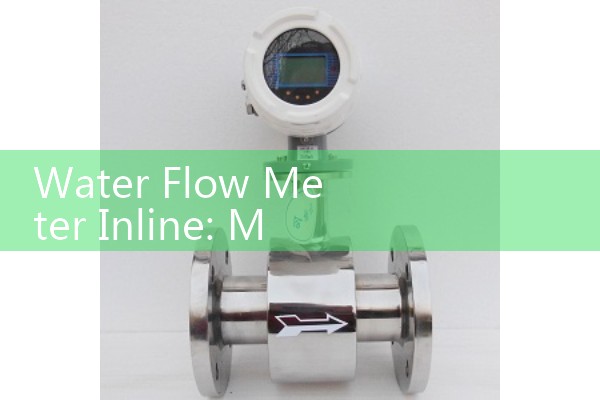
For projects that need remote reading or high accuracy from very low to high flow, we offer digital inline meters. The electromagnetic version works on the Faraday principle and has no moving parts. It can measure forward flow only or forward/reverse flow. Accuracy is typically ±0.5% of reading or better. These meters come with a compact transmitter powered by 24 V DC or battery. Output options include 4-20 mA, pulse, Modbus RTU over RS485, and M-Bus for European-style building automation.
In the Middle East, we recently shipped ultrasonic inline meters for a 120-villa compound in Saudi Arabia. They selected DN15 ultrasonic meters with built-in valves and M-Bus communication. The system reads 120 meters on a single bus and sends data to the central SCADA. Because ultrasonic meters have no mechanical parts, they do not suffer from wear in sandy water that c
How to choose between mechanical and digital for your project
Budget usually decides. Mechanical meters are still the most affordable if you only need a local readout and a pulse for basic monitoring. Digital meters cost more upfront but eliminate mechanical wear and give you more data. If the water has suspended solids or if you need to detect leaks with very low flow rates, a digital meter will pay for itself in reduced maintenance.
Here is a practical example. A water authority in Kenya replaced 200 mechanical meters with electromagnetic inline meters in a district metering area. The new meters detected a persistent 0.3 m³/h leakage at night that the old meters could not register because it was below their start-up flow. The payback from water savings was under 14 months.
Typical specifications and what to send us for a quote
When you reach out to us, a few details cut the back-and-forth time by half. Tell us the nominal pipe diameter (DN15, DN20, DN25, DN32, DN40). Describe the fluid (potable water, non-potable water, hot water up to 90 °C). Give us the flow range you expect: minimum, normal, and maximum flow in m³/h or L/h. Specify the output you need: pulse, 4-20 mA, RS485 Modbus, M-Bus, or a simple local mechanical totalizer. We also need the operating pressure in bar and the process temperature in °C. If the meter will be installed in a pit that may flood, we recommend IP68. For indoor installation, IP65 is usually enough.
Send all of that to [email protected]. Our engineers will reply with a data sheet, a dimensional drawing, and a firm price within one working day. You can also reach us by phone at +86-25-68650347 or on WhatsApp at +86-25-52155837. For a quick chat on WeChat, add +86 15365082610.
FAQ: Inline water flow meters with valves
Q: Can I get a mechanical inline water meter with pulse output and valve for DN25 pipe?
A: Yes. A typical configuration is a DN25 multi-jet brass meter with an integrated ball valve, pulse output (10 L/pulse or 100 L/pulse), and IP68 register. We ship this assembly worldwide from stock.
Q: Do your digital meters work with M-Bus for European-style building automation?
A: Absolutely. Our electromagnetic and ultrasonic inline meters can be ordered with integrated M-Bus, powered by the bus or by an external 24 V DC supply. The M-Bus interface complies with EN 13757-2.
Q: What is the minimum flow rate for your DN15 ultrasonic meter?
A: The start-up flow is as low as 1 L/h. The meter can measure down to 2 L/h with a specified accuracy, which makes it suitable for leak detection in residential zones.
Q: Do you offer hot water versions?
A: Yes. We supply mechanical meters for water up to 90 °C and ultrasonic meters for up to 130 °C, depending on the material selection. Please specify the temperature when you send your inquiry to [email protected].
Q: Can Silver Instruments provide type approval or calibration certificates?
A: We provide factory calibration certificates traceable to national standards. We also assist with MID or OIML type approval certificates for specific models when required by local regulations.