

『Diesel Oil Flow Meter 4 Inch Pipeline Assembly Benchmarks』Related information(clamp on meter|electromagnetic meter|venturi meterrotameter|orifice meter|ultrasonic flow meter|mass flow meter|coriolis mass flow meter|coriolis flow meter|magnetic flow meter|magmeter flow meter|magflow flow meter|mag meter flow meter|electromagnetic flow meter|vortex flow meter|turbine flow meter|thermal mass flow meter|thermal flow meter|rotameter flow meter)
Diesel Oil Flow Meter 4 Inch Pipeline Assembly Benchmarks
Quick Answer: For a 4 inch (DN100) diesel oil pipeline, a positive displacement meter like an oval gear flow meter gives the best repeatability and long‑term accuracy. You need a minimum upstream straight run of 10 pipe diameters, a Y‑type strainer with 250 micron mesh, and an air vent at the high point. Calibration bench data from 20 cSt diesel at 40 °C and 6 bar line pressure shows a typical turndown of 10:1 with ±0.5% accuracy.
We set up dozens of 4‑inch diesel metering skids each year for fuel depots, generator farms, and marine bunkering customers across Southeast Asia and the Middle East. The assembly benchmarks you choose directly affect custody transfer reliability. Most engineers skip over the small mechanical details, but those details are what prevent a meter from drifting after 3 months of 24/7 operation.
Straight Pipe and Flow Conditioning
Positive displacement meters are less sensitive to flow profile disturbances than turbine or ultrasonic meters, but that does not mean you can ignore straight runs altogether. Here is the thing: diesel often carries microscopic rust particles and wax residues that create asymmetric wear if the flow enters the measuring chamber with swirl. On a 4‑inch schedule 40 pipe, we specify 10D upstream straight and 5D downstream straight as the assembly benchmark. For DN100 this means 1000 mm of uninterrupted pipe before the meter and 500 mm after it. No elbows, no partially open valves, no thermowells poking into the stream. In practice, many site crews try to install the meter right after a 90‑degree bend to save space. Do not let them.
Mounting Orientation and Air Venting
A horizontal mounting configuration with the meter register facing up or sideways is the standard for oval gear meters in diesel service. Vertical assemblies work only if you are sure the line is always full of liquid and you have a way to bleed air during commissioning. Diesel lines often run intermittently, especially on emergency generator feeds. When the pump stops, the pipe can drain back and pull in air. Air slugs hitting the oval gears accelerate wear and give false totals. Because of that, every 4‑inch assembly we design includes a ball valve vent at the highest point of the meter run, upstream of the meter, combined with a check valve downstream to hold back pressure. A few customers in Nigeria running 4‑inch truck loading gantries found this simple vent reduced totalizer drift from 2% to under 0.3% after two months of daily use.
Strainer Selection for Real Diesel Conditions
Diesel viscosity is not a single number. It might be 3 cSt on a hot afternoon in Saudi Arabia and 15 cSt before sunrise in a Peruvian mine at 4000 meters elevation. That viscosity swing changes how debris settles and how the strainer pressure drop behaves. For a 4‑inch line with a flow range between 15 m³/h and 120 m³/h, we benchmark a Y‑type strainer with a 40 mesh (approximately 400 micron) screen for clean diesel and 60 mesh (250 micron) for fuel that has passed through storage tanks. The strainer body should be the same DN100 size as the pipe to keep the pressure loss below 0.1 bar at maximum flow. A duplex strainer is even better if the diesel has been sitting in a day tank for weeks, because you do not want to shut down a mid‑shift transfer operation to clean the basket. One food additive plant in Thailand switched to duplex strainers after their cleaning cycle went from 8 hours to 2 hours during peak production.
Calibration and Performance Benchmarks for 4‑Inch Diesel Lines
All Silver Instruments oval gear flow meters for diesel leave our factory with a water calibration certificate based on a 40 °C reference temperature and a 10:1 turndown. For a DN100 meter, the typical calibrated span runs from 10 m³/h to 100 m³/h. We have seen actual diesel bench tests at a customer facility in Jakarta where the meter repeated within ±0.15% across five consecutive batches of 20,000 liters, using a master meter traceable to OIML R117. The liquid temperature stayed between 30 °C and 45 °C, and the line pressure was held at 5 to 7 bar. If your operating pressure goes above 15 bar, we add a reinforced graphite gasket on the cover and upgrade the pulse output pickup to a hermetically sealed version. Many 4‑inch diesel meters running in marine bunkering in Dubai work at 10 bar with zero leaks after two years because of that simple upgrade.
Pulse Output and Signal Handling
Diesel is flammable, so the signal from the meter often needs to
A Real‑World 4‑Inch Diesel Transfer Skid
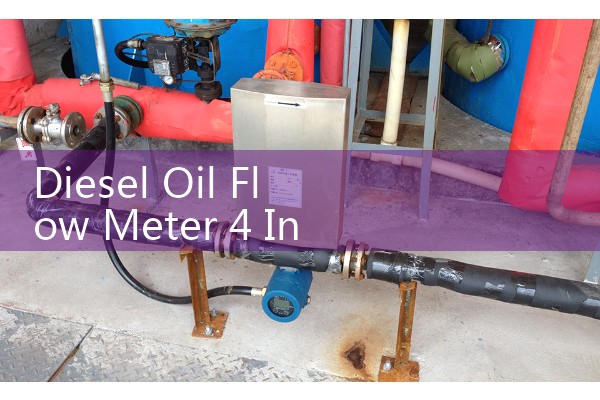
Last year a customer in Vietnam needed a portable skid to transfer diesel from storage to barges on the Mekong River. The skid used a DN100 oval gear meter with ANSI 150 flanges, a duplex strainer, an air vent on a short riser, and a 10D upstream spool piece. The operating flow settled at 60 m³/h most of the time, with occasional peaks of 95 m³/h. After 4000 running hours, the meter was pulled and inspected. The oval gears showed no measurable wear, and the calibration shift was less than 0.2%. The strainer baskets, however, needed monthly cleaning because of silt and organic fibers common in river‑side tank farms. That single data point is why we always tell project engineers: benchmark your filter maintenance intervals before you benchmark the meter itself.
Which Silver Automation Instruments Flow Meter Fits a 4‑Inch Diesel Line
For diesel oil in a DN100 pipeline, we typically recommend the Silver Instruments OGF‑DN100 oval gear flow meter with an aluminum or cast iron body, PTFE internals, and a high‑resolution reed switch or Hall effect pulse transmitter. The flow range covers 10 to 120 m³/h at viscosities between 2 and 200 cP, and the standard accuracy is ±0.5% of reading across the full flow range. If the diesel is blended with biodiesel (B20 or B30), we upgrade the seals to Viton. For custody transfer applications, the meter can be supplied with an OIML R117 pattern approval certificate and a field calibration report from our ISO 17025 accredited partner lab. To get a specific quote, send us your operating pressure in bar, flow range in m³/h or liters per minute, diesel viscosity if known, and pipe connection standard (ANSI 150, JIS 10K, or DIN PN16). Our team will return a dimensioned mechanical drawing and a pricing proposal within the same business day.
FAQ
1. Can I install the meter in a vertical 4‑inch diesel line?
Yes, but only if the flow is upward and the line is always flooded. Horizontal mounting gives better venting and less risk of dry running. If you must use a vertical assembly, add an automatic air vent before the meter.
2. What is the pressure drop across a DN100 oval gear meter at 80 m³/h?
On diesel at 3 cSt, the pressure drop is typically 0.3 to 0.5 bar. On heavier fuels around 50 cP, it can reach 1.0 bar. Always size the strainer and check valve to contribute no more than 0.1 bar additional loss.
3. Do I need flow conditioning plates for positive displacement meters?
No, positive displacement meters do not need flow straighteners. The oscillating measuring chamber mechanically averages the flow. The straight pipe recommendation is for mechanical wear reduction, not for profile correction.
4. How often should I recalibrate a diesel meter on a 4‑inch custody transfer line?
We recommend a field proving or lab recalibration every 12 months or after every 10 million liters transferred, whichever comes first. Many depots use a compact master meter (a smaller DN50 oval gear meter) as a reference for online verification.
5. Can I use the same DN100 meter for diesel and for low‑viscosity solvents?
Physical size wise, yes, but be careful. If you switch to a solvent with viscosity below 1 cP, the internal leakage (slip) increases, and the meter will under‑register at low flows. For multi‑fluid service, ask our engineers to select a meter with tighter clearance class and provide a multi‑point viscosity calibration curve.
Next step: Send our application team your pipe size (DN100 or other), diesel pressure and temperature, required flow range, and any hazardous area certification needed. We will return a specific model recommendation with the full assembly drawing and a net price valid for 30 days. Reach us at Silver Automation Instruments.
 Hot News
 Related AD