

『Doppler Flow Meter Selection Guide: Best Practices For Slurry And Wastewater Measurement』Related information(clamp on meter|electromagnetic meter|venturi meterrotameter|orifice meter|ultrasonic flow meter|mass flow meter|coriolis mass flow meter|coriolis flow meter|magnetic flow meter|magmeter flow meter|magflow flow meter|mag meter flow meter|electromagnetic flow meter|vortex flow meter|turbine flow meter|thermal mass flow meter|thermal flow meter|rotameter flow meter)
Doppler Flow Meter Selection Guide: Best Practices For Slurry And Wastewater Measurement
Quick Answer: Doppler ultrasonic flow meters are the go-to choice when your fluid contains suspended solids, gas bubbles, or anything that scatters sound. If you measure raw sewage, sludge, mining slurry, or dredging flows, a clamp-on Doppler meter from Silver Automation Instruments gives you a non-invasive install with no pipe cutting and no pressure drop. Send us your pipe size (DN), material, solids concentration, and flow range and we will recommend the right sensor within one business day.
Why Doppler Wins In Dirty Water And Slurry
Transit-time ultrasonic meters need a relatively clean liquid. Their signal must travel straight from one transducer to the other. Once bubbles or solid particles exceed roughly 2% by volume, the acoustic path gets blocked and the meter fails. Doppler meters work the opposite way. They deliberately rely on particles or bubbles to reflect the ultrasonic signal back to the sensor. Real wastewater and slurry applications always fall into this category.
In practice, a transit-time meter might work for a week in a secondary clarifier effluent line. Then a storm surge brings grit and rags and the reading drops to zero. A Doppler meter handles that same surge without blinking. We have seen this pattern at many municipal plants in Southeast Asia, especially during the monsoon season in Thailand and Vietnam.
When To Pick Doppler Over Transit-Time
Engineers often ask us for a single rule. Here is what we tell them: if you can see through a sample jar in normal light, try transit-time. If the liquid looks like coffee with milk, mud, or worse, start with Doppler. Typical triggers include:
Total suspended solids (TSS) above 200 mg/L, but anything over 1000 mg/L almost always needs Doppler
Gas bubble content over 2% volume, common in aerobic digester sludge or dissolved air flotation (DAF) effluent
Applications with inconsistent fluid, such as combined sewer overflows (CSO) or mine dewatering where slurry concentration changes by the hour
Most engineers skip this part, but also check velocity. Doppler needs a minimum flow velocity of around 0.03 m/s for reliable operation. Below that, you may need a meter with a higher-frequency sensor or a specially programmed damping output. Silver Instruments can help with that.
Pipe Material, Mounting, And Couplant Reality
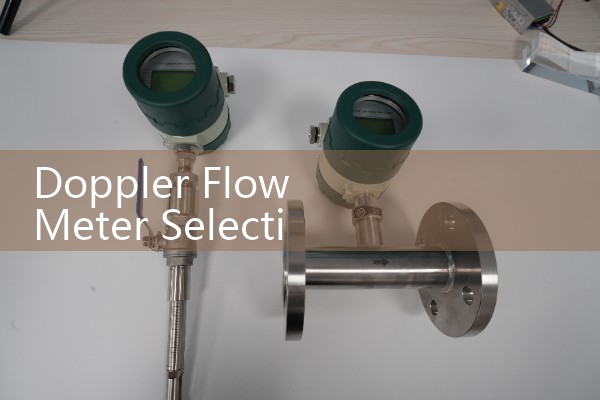
Clamp-on Doppler meters attach to the outside of the pipe. The ultrasonic signal must pass through the pipe wall, reflect off particles, and return. That sounds simple. The reality is different with rusty pipes, concrete, or old fibreglass.
Excellent performance: carbon steel, stainless steel, PVC, HDPE, cast iron, copper (typical wall thickness up to 25 mm).
Poor or zero performance: unlined concrete, wood stave, rubber-lined pipe, heavily corroded pipe with air gaps inside the scale. In those cases, a spool-piece insertion meter is often the only reliable fix. Silver Instruments offers both clamp-on and insertion Doppler models for exactly this reason.
Use a generous blob of acoustic coupling gel. In hot climates like the Middle East or Western Australia, check the gel regularly. It can dry out in weeks when pipe surface temperatures exceed 60 °C. We ship high-temperature couplant with every order to GCC countries for this reason.
Typical Installations That Work Every Day
Last year a copper mine in Chile asked us to replace a magnetic flow meter on their tailings thickener underflow. The mag meter electrodes coated in days and the reading drifted. We proposed a clamp-on Doppler meter on the DN200 HDPE line with 35% solids by weight. The meter has been running for 18 months with no zero drift and no electrode cleaning. Their maintenance team only wipes dust off the transmitter housing once a month.
At a palm oil effluent pond in Indonesia, a vertically mounted clamp-on Doppler on a DN150 PVC pipe measures flow after a coarse screen. The effluent has oil,
A municipal wastewater plant in Nigeria uses a Doppler meter on their return activated sludge (RAS) line. The pipe is DN300 ductile iron with a cement lining inside. Because the cement lining was smooth and well-bonded, the Doppler signal transmitted fine. Their operator reads the totalised flow directly from the meter and cross-checks it with the aeration basin mass balance once a week.
Model Selection And Output Options
Silver Automation Instruments supplies Doppler flow meters in two main forms. The SD-M series is a clamp-on sensor with an IP65 transmitter, suitable for pipes from DN20 to DN4000. Outputs include standard 4-20 mA, pulse, and RS485 Modbus. For areas requiring explosion protection, we configure the transmitter in an Ex d enclosure certified to ATEX Zone 1 or IECEx.
For permanent insertion applications or open channels paired with a flume, we offer the SDU-200 series. It includes a 316L stainless steel sensor body, PT100 temperature input for heat measurement, and an optional internal data logger. You can integrate it into any plant SCADA via Modbus RTU or HART, without an extra converter.
Because every site is different, we do not publish a one-size-fits-all price list. Instead, send us the following: pipe outer diameter and material, wall thickness, fluid description and approx TSS, normal and maximum flow velocity, fluid temperature, and ambient conditions. We return a technical proposal with a sensor selection, mounting arrangement drawing, and a FOB Shanghai or CIF port price within 48 hours.
Installation Pitfalls To Avoid
Mount the sensor on a pipe section that runs full. A partially filled pipe scatters the ultrasonic signal in unpredictable ways and the meter will under-read or fail. Choose a vertical section flowing upward if possible, or a horizontal section at a low point where the pipe stays full. Upstream straight run should be at least 10 pipe diameters, downstream 5 pipe diameters; more if a pump or a butterfly valve sits directly upstream.
Slurry can settle to the pipe bottom at low velocities. The Doppler meter averages velocity across a portion of the flow profile. If solids settle heavily, the reading may shift. We have seen this on a gold mine tailings line in Ghana where the operator mistakenly placed the sensor on a long horizontal section with less than 0.2 m/s velocity. Relocating the sensor to a vertical riser solved the error immediately.
FAQ: The Five Questions We Answer Every Week
Can I use a Doppler meter on a pipe smaller than DN25? No. The sensor face is sized for DN25 and above. For micro-flow slurry, a small Coriolis meter is a better option if the solids are not too abrasive.
Does the pipe need a special coating removed? Only if the coating traps air. Epoxy and cement linings that are sound-bonded work fine. Loose wrap or fibrous insulation must be removed under the sensor.
How do I calibrate a Doppler meter after installation? We calibrate each sensor at our factory against a traceable standard. In most slurry applications, on-site calibration is not needed. If you have a reference flow meter or a tank dump test, you can adjust the span factor via the menu.
Will hydrogen sulphide gas affect the clamp-on sensor? No. The sensor is outside the pipe. The electronics should be installed away from the direct vent, but the sensor itself sees no H2S.
Can I run long cable between sensor and transmitter? Yes, up to 150 metres with our shielded cable. For longer distances, mount the transmitter closer and use RS485 Modbus to the control room.
For a project quotation, email us at [email protected] with your pipe size (DN), material, wall thickness, fluid solids content, and flow range. Our application engineers will reply with a sensor model, installation notes, and a commercial offer the same day if received before 10:00 AM UTC+8.
 Hot Product
 Related AD