
 About Us
Coriolis Effect Flow Meters: Advanced Inertial Force Sensors for High-Viscosity Fluids
Quick Answer
Coriolis effect flow meters measure high viscosity fluids directly by mass. They do not need a velocity profile or a viscosity correction factor. Silver Automation Instruments supplies these meters for syrups, heavy oils, resins and slurries from 1 cP to above 50000 cP with 0.1% to 0.2% accuracy.
How a Coriolis Meter Acts as an Inertial Force Sensor
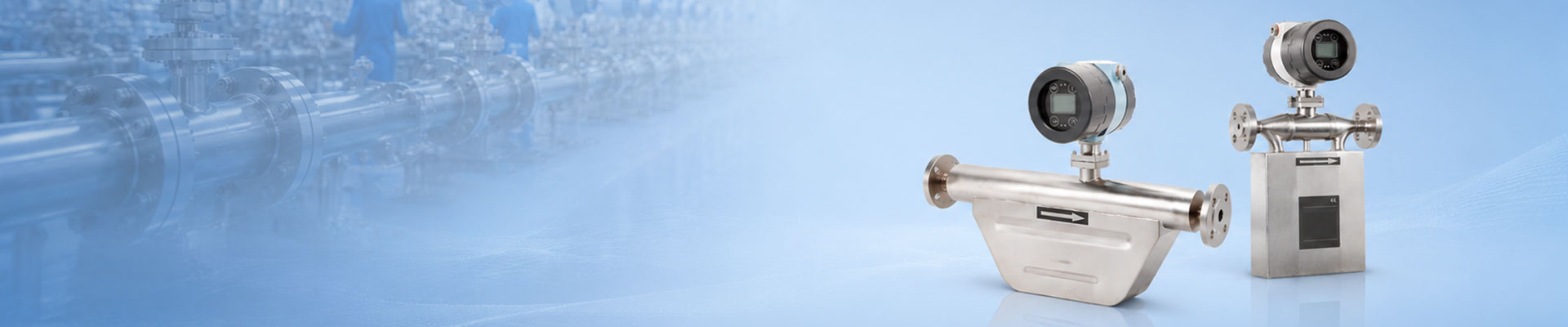
A Coriolis flow meter is an inertial force sensor. The meter drives one or two tubes into vibration. Mass flow moves through the tubes. The inlet section of the tube shifts phase against the outlet section. That phase shift is directly proportional to mass flow rate. Density is measured from the resonant frequency. A PT100 sensor reads process temperature at the tube wall.
This principle works well when the fluid is dense and viscous. High viscosity liquids produce a clean phase signal because they move with less turbulence. The meter does not rely on Reynolds number, so laminar flow is not a problem. That gives Coriolis meters a strong position in heavy oil, molasses, glue and polymer applications.
High Viscosity Fluids Where the SILVER CMF Series Fits
Most process engineers define high viscosity as anything above 500 centipoise. Medium viscosity runs from 500 to 5000 cP. Heavy fuel oil, corn syrup, alkyd resin, latex adhesive and polymer melts often sit between 5000 and 50000 cP. Here is the thing. These fluids cause wear in mechanical meters. An oval gear meter may drift after a few months. A Coriolis meter has no moving parts in the flow stream. That is the main reason plants choose it for sticky or abrasive service.
We supplied a DN25 SILVER CMF meter to a paint maker in Vietnam. The line runs at 12000 cP and 85 °C. Their previous oval gear meter lost accuracy after six months because of gear wear. The SILVER CMF meter held 0.15 percent of rate for over one year without recalibration. That site now uses three more units on resin and solvent lines.
Installation Notes for Viscous Service
Here is the thing. Pressure drop is the first thing to check. High viscosity increases pressure loss across any meter. For a 5000 cP fluid, a DN25 bent tube meter can add 0.3 to 0.8 bar at 2000 kg/h. The back pressure must be high enough to prevent gas breakout. In practice, we tell users to keep 0.5 bar minimum back pressure on 5000 cP liquids. For 20000 cP, target 1 bar or more depending on vapour pressure.
The meter needs straight pipe sections per the manufacturer drawing. Most SILVER CMF models need zero straight run if installed after a pump. If a control valve sits downstream, keep the meter inlet pressure stable. Vibrations from nearby pumps or compressors can disturb the signal. Use pipe supports on both sides of the meter and avoid long unsupported spans. Most engineers skip the support check. We have seen this on customer sites many times. Pipeline vibration shifted a zero point by 0.2 kg/h on a small DN15 line.
Accuracy and Range Considerations
The SILVER CMF series covers DN15 to DN100. Accuracy ranges from 0.1% to 0.2% of rate for liquids above 20 percent of nominal flow. Below that, accuracy is stated as a zero stability value in kg/h. For a DN25 meter, zero stability may be 0.5 kg/h. A flow range of 100 to 5000 kg/h is typical for this size. Turndown is often 20 to 1 or better. Density accuracy is 0.0005 g/cm³. Process temperature limits are -50 to 150 °C for standard models and up to 200 °C for high temperature versions. Pressure ratings are 40 bar standard and 100 bar on request. Outputs include 4 to 20 mA HART, pulse and Modbus RTU. ATEX Zone 1 and IECEx versions are available for hazardous area service.
Do not expect the same low flow cut off as a thermal mass meter. Very low flows below the zero stability limit become noisy. But for batch loads above 50 kg, a Coriolis meter handles start and stop conditions well. The meter does not need a flow conditioner. Because the meter measures mass, temperature compensation for volume is not required. That saves engineering time on fuels and edible oils where density changes with grade.
When a Coriolis Meter Is Not the Right Fit
The limitation is not viscosity. Gas bubbles and low process pressure cause more errors. Entrained air damps the tube and causes the reading to jump. Install an air release or maintain back pressure. For very abrasive slurries, tube erosion can be a concern. Silver Automation Instruments offers 316L stainless steel tubes as standard and Hastelloy C22 on request. Hard particles above 5 percent by volume may shorten tube life. In that case, a magnetic flow meter or an ultrasonic flow meter may cost less. But for clean high viscosity liquids, the SILVER CMF series is a solid choice.
Getting a Quote with Real Process Data
Send us your flow range in kg/h, viscosity in cP, pressure in bar, temperature in °C and pipe size DN. We will propose a specific meter model and send a price. Call Silver Automation Instruments at +86-25-68650347. Send a WhatsApp message to +86-25-52155837. WeChat ID is +86 15365082610. You can also visit flow-meter.com.au for specifications. Silver Automation Instruments is a flow meter manufacturer based in Nanjing, China.
Five FAQ for Engineers and Buyers
What viscosity limit applies to a Coriolis flow meter?
Standard SILVER CMF meters handle 1 cP to 50000 cP. High viscosity versions cover up to 100000 cP. Very high viscosity increases pressure drop, so we check line size and pump head.
Does a Coriolis meter need viscosity compensation?
No. The meter measures mass flow directly. Viscosity changes from 100 cP to 10000 cP do not shift the calibration. Density and temperature outputs are included.
Can a Coriolis meter measure heavy fuel oil with 10 percent water?
Yes. It measures the total mass flow including water. For net oil flow, pair it with a water cut meter. Density output helps estimate water content if densities are known.
What is the smallest line size for syrup batching?
DN15 is the smallest standard size. It works well for batch loads from 10 kg to 2000 kg per hour. For larger syrup lines, DN25 or DN40 gives lower pressure drop.
How often does a Coriolis meter need recalibration?
For clean service, every two years works. For abrasive or fouling service, check every 12 months. The meter zero point can be verified on site with the block valves closed.
 Contact Us
 Related AD