

『Thermal Mass Flow Meter Principle & Application』Related information(clamp on meter|electromagnetic meter|venturi meterrotameter|orifice meter|ultrasonic flow meter|mass flow meter|coriolis mass flow meter|coriolis flow meter|magnetic flow meter|magmeter flow meter|magflow flow meter|mag meter flow meter|electromagnetic flow meter|vortex flow meter|turbine flow meter|thermal mass flow meter|thermal flow meter|rotameter flow meter)
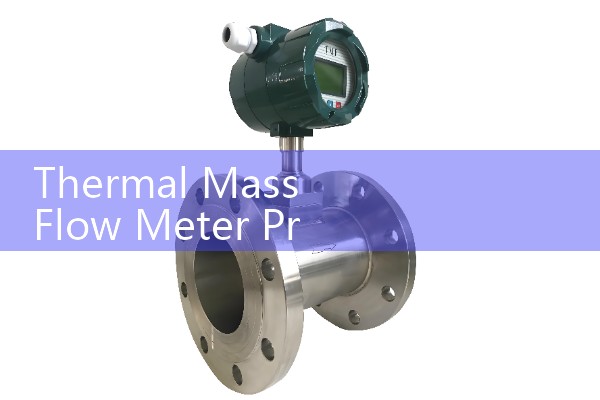
Thermal Mass Flow Meter Principle and Applications
Quick Answer: Thermal mass flow meters measure gas mass flow rate directly. They do not need external temperature or pressure compensation. This makes them a reliable choice for applications like natural gas distribution, compressed air monitoring, and biogas measurement.
How the Constant Temperature Difference Principle Works
Most industrial thermal mass flow meters use the constant temperature difference method. Two platinum RTD sensors are inserted into the gas stream. One sensor measures the gas temperature (reference sensor). The other sensor is self-heated and kept at a fixed temperature differential above the gas temperature. As gas flows past the heated sensor, it cools it down. The electronics increase power to maintain the delta-T. The power required is proportional to the mass flow rate. This relationship is nonlinear, so the transmitter uses a calibration curve stored in its memory. The result is a 4-20 mA HART output or pulse signal you can send to a PLC or flow computer.
Common Applications in Oil and Gas, Chemical, and Food Plants
We see these meters mostly on gas lines. Natural gas custody transfer for boilers and burners is a classic use. A natural gas distribution company in Indonesia used DN50 thermal mass flow meters with Modbus RTU for billing sub-meters. Compressed air systems in automotive factories also rely on them to find leaks and manage energy costs. Biogas measurement is growing fast in Southeast Asia. A tapioca starch plant in Vietnam installed our stainless steel 316L probe to measure biogas with 65% CH4 at 40°C and low pressure. The meter outputs directly in Nm3/h, which is helpful for operators who do not want to convert volume to mass. In chemical plants, thermal mass flow meters handle nitrogen purge, CO2 injection, and flare gas lines. They work well when the gas is dry and clean. If moisture or particles are present, you need a filter.
Key Specifications to Specify Before You Buy
Engineers often ask us for a price without the full set of parameters. Here is the thing: without gas type, pressure, temperature, and pipe size, we cannot quote an accurate model. Please provide the gas composition or at least the main component, flow range in kg/h or Nm3/h, operating pressure in bar, temperature in °C, and pipe diameter like DN25, DN50, or DN80. The wetted materials matter too. Standard probes are 316L stainless steel with a Hastelloy C option for corrosive gases. Process connections are typically ½ inch NPT or flanged DN25. For hazardous areas, request ATEX Zone 1 or IECEx certification. Output signals can be 4-20 mA HART, Modbus RS485, or pulse. Power supply is 24 V DC. The display shows totalized flow and instantaneous flow rate. Our meters accept gas temperature from -20°C to +120°C and pressure up
Installation Tips That Prevent Measurement Errors
We have seen on customer sites many times that installation mistakes cause more problems than the meter itself. The number one rule: you need a straight run of pipe. Typically 15 pipe diameters upstream and 10 diameters downstream for inline meters. For insertion probes, 20D upstream and 10D downstream. Avoid placing the sensor right after a valve or an elbow. Condensation in the gas is another common issue. Even small water droplets on the heated sensor will cause a spike in the reading. Install a moisture trap or mount the probe at an angle so liquids drain away. Most engineers skip this part, but it matters more than the accuracy spec. Also, do not install the meter in a dead leg where there is no real flow. This cooks the sensor and drifts the calibration. A food factory in the Philippines struggled with erratic readings on nitrogen. We found the probe was mounted upside down and exposed to oil carryover. A simple repositioning fixed it.
Frequently Asked Questions
What gases can a thermal mass flow meter measure?
It measures clean, dry gases such as natural gas, compressed air, nitrogen, oxygen, carbon dioxide, argon, and biogas. Liquids, slurries, or gases with more than 1% by volume moisture typically cause errors.
Does a thermal mass meter need temperature and pressure compensation?
No, it measures mass flow directly. You do not need external pressure or temperature transmitters for accuracy. This is a major advantage over volumetric meters.
What is the typical accuracy?
Standard accuracy is ±1% of reading plus ±0.5% of full scale. For custody transfer, higher accuracy models are available. Calibration against a NIST-traceable standard is recommended.
Can it handle wet or dirty gases?
Not well. Liquid droplets or sticky particles cause reading spikes and sensor drift. Use a filter and coalescer upstream. For saturated biogas or flare gas, consider a Coriolis mass flow meter from Silver Instruments instead.
What is the smallest pipe size?
Inline thermal mass flow meters start at DN15. For smaller lines, we recommend a Coriolis meter. Insertion probes work in pipes from DN100 up to DN2000.
To get a quote or technical recommendation, send us your gas type, pressure (bar), temperature (°C), pipe size (DN), and flow range. Our engineers at Silver Automation Instruments will reply within 24 hours with a datasheet and price. Visit flow-meter.com.au or write to [email protected].
 Hot Blog
 Related AD