

『How to Install Water Flow Meter: Best In-Line Orientations for Horizontal Piping Loops』Related information(clamp on meter|electromagnetic meter|venturi meterrotameter|orifice meter|ultrasonic flow meter|mass flow meter|coriolis mass flow meter|coriolis flow meter|magnetic flow meter|magmeter flow meter|magflow flow meter|mag meter flow meter|electromagnetic flow meter|vortex flow meter|turbine flow meter|thermal mass flow meter|thermal flow meter|rotameter flow meter)
How to Install a Water Flow Meter: Best In-Line Orientations for Horizontal Piping Loops
Quick Answer: For horizontal water piping loops, install the flow meter with the sensor electrodes or transducers on the horizontal axis. Keep the meter body full at all times. Avoid the top high point where air collects and the bottom low point where sludge settles. A side mounted electrode orientation works best for electromagnetic flow meters on DN15 to DN300 water lines.
This guide covers inline and clamp-on water flow meter mounting for horizontal loops. We focus on electromagnetic flow meters, ultrasonic flow meters, Coriolis mass flow meters, and oval gear flow meters. The recommendations come from field service work in Southeast Asia, the Middle East, Latin America, and Africa.
Why Horizontal Piping Loops Need Special Flow Meter Orientation
Horizontal piping loops are common in cooling water returns, pump discharge headers, and wastewater transfer lines. The main problems are air pockets at the top and sediment at the bottom. A partially filled pipe creates a bad velocity profile and false readings. This happens often on customer sites with long pipe racks and poor pipe support.
Here is the thing. A flow meter is not a pressure gauge. It needs a stable and full pipe section. In a horizontal loop, the meter should sit in the lower half of the pipe run but not at the very bottom. This keeps the sensor wet and reduces sludge contact.
Best Inline Orientation for Electromagnetic Flow Meters
For a DN25 to DN300 electromagnetic flow meter on potable water, cooling water, or wastewater, mount the meter with the measuring electrodes side by side. Imagine the pipe cross section as a clock face. The electrodes should sit at the 3 and 9 positions. Do not put the electrodes at the 12 and 6 positions. Air at the top breaks electrode contact. Sludge at the bottom coats the lower electrode.
The process liquid should have conductivity above 5 µS/cm. For demineralized water or reverse osmosis permeate below 5 µS/cm, use a capacitive electromagnetic meter or an ultrasonic flow meter. Send us your conductivity value, pipe size (DN), and flow range. Silver Automation Instruments engineers will suggest a suitable model with 4-20 mA HART output.
Coriolis Mass Flow Meter Mounting in Horizontal Loops
Coriolis meters work well in horizontal loops if the measuring tubes stay full. Mount the sensor so the flow splitter or manifold sits horizontally. For a dual tube Coriolis meter, side by side tube orientation helps gas bubbles pass through. This is useful on chemical batching, palm oil, and food additive lines where viscosity changes from 2 cP to 500 cP.
Support the meter body on both sides. Use pipe supports every 2 m for DN25 to DN80 lines. This reduces zero drift caused by pump vibration. A paint manufacturer in Indonesia changed a solvent batching Coriolis meter from vertical to horizontal tube orientation. The startup error dropped from 0.8 percent to 0.15 percent.
Ultrasonic Flow Meter Mounting Rules for Horizontal Water Lines
For clamp-on and inline ultrasonic flow meters on horizontal water loops, mount the transducers on the side of the pipe. Do not mount them on the top or bottom. Top mounting collects air bubbles. Bottom mounting collects sediment. For DN50 to DN150 pipes, use W path mounting. For larger DN200 to DN600 pipes, use Z path mounting.
Keep 10D straight pipe upstream and 5D downstream. In practice, most engineers skip the downstream straight run when space is tight. That creates a repeatability drift of 0.5 percent to 1 percent on clamp-on ultrasonic meters. If space is very tight, use a flow conditioner or switch to an inline electromagnetic meter.
Oval Gear Flow Meter Orientation on Horizontal Diesel and Water Lines
Oval gear meters must be mounted with the gear shaft horizontal. The pipe inlet and outlet should stay on the same horizontal plane. Never mount the meter upside down. Dirt from the pipe drops into the gear chamber and blocks the rotors. Install a Y strainer with 10 to 20 mesh upstream. This applies to diesel, heavy fuel oil, palm oil, and high viscosity water based fluids up to 10
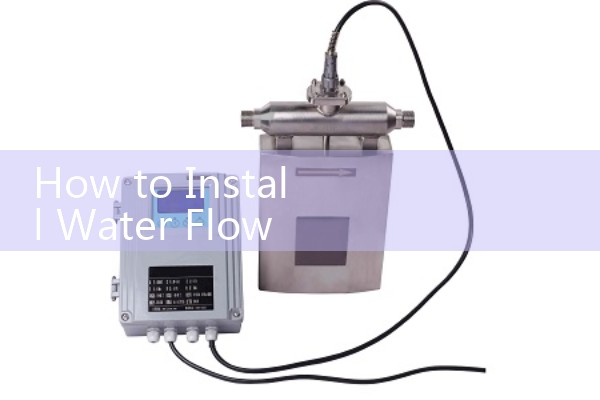
We supply oval gear flow meters with pulse output and 4-20 mA HART for diesel transfer, boiler fuel measurement, and batch control. For water service, an oval gear meter is not the first choice unless the water has low flow and high viscosity additives.
Installation Steps for a Horizontal Piping Loop
Step 1. Drain the piping loop and mark the meter position between two pipe supports.
Step 2. Cut the pipe and weld flanges or wafer alignment rings. Keep the internal weld bead below 1.5 mm.
Step 3. Install the flow meter so the flow arrow matches the process flow direction.
Step 4. Center the gasket. A protruding gasket changes the flow profile and shifts the calibration factor.
Step 5. Tighten the flange bolts in a star pattern. Use a torque wrench if the vendor supplies a torque table.
Step 6. Fill the loop slowly. Vent air from the high point before the meter. Close the downstream valve briefly to check the meter stays full.
Step 7. Configure the 4-20 mA HART output range to match the DCS or PLC. The default range for many electromagnetic meters is 0 to 10 m/s.
Common Mistakes Found on Customer Sites
Do not install a flow meter right after a 90 degree elbow. Swirl shifts the velocity profile and causes a low flow offset. A water treatment plant in Chile installed a DN100 electromagnetic meter after an elbow and saw a 2 percent offset at low flow. Moving the meter to a 10D upstream straight run fixed it.
Do not mount the meter at the highest point of a horizontal loop. A small air pocket can stop an electromagnetic meter. Do not mount it at the lowest sagging point where sludge builds up. We have seen this on customer sites many times. A wastewater plant in Malaysia kept losing signal on a DN150 mag meter. The meter sat at the bottom of a sagging pipe rack. After adding pipe supports and moving the electrodes to the side orientation, the signal stayed stable.
Which Water Flow Meter Type Should You Choose for a Horizontal Loop
For clean water, cooling water, or potable water from DN15 to DN300, choose an electromagnetic flow meter. For large pipes above DN200, an inline or clamp-on ultrasonic meter can reduce installation cost. For batching chemicals, dosing coagulants, or measuring mass, choose a Coriolis mass flow meter. For diesel fuel transfer or high viscosity oil, choose an oval gear flow meter. Silver Automation Instruments supplies all these types with pulse output, 4-20 mA HART, RS485 Modbus, and wireless options.
FAQ
Can a water flow meter be installed vertically in a horizontal piping loop?
Yes. Use vertical installation with upward flow if the water has solids or sludge. This keeps the meter full and reduces sediment. Avoid vertical installation with downward flow because the pipe can drain and create an empty meter condition.
What is the minimum straight pipe required for a magnetic flow meter in a horizontal loop?
Keep 5D upstream and 3D downstream for most electromagnetic flow meters. If the meter follows a pump, valve, or elbow, increase the upstream straight run to 10D. For DN80 and smaller lines, 5D is usually enough.
How do you prevent air bubbles in a horizontal water flow meter?
Install an air release valve upstream of the meter. Keep the pipe velocity above 0.5 m/s in horizontal lines. Mount the meter electrodes side by side. Avoid placing the meter on a pump suction line without a priming valve or air separation device.
Does a Coriolis flow meter need straight pipe in a horizontal loop?
Coriolis meters do not need straight pipe because they measure mass directly. However, the meter body needs proper support on both sides. Vibration from a horizontal loop can disturb the zero point. Use rigid pipe supports and avoid long unsupported spans.
What information should I send for a water flow meter quotation?
Send us the pipe size (DN), fluid type, conductivity if using a magnetic meter, flow range in m3/h or kg/h, pressure (bar), temperature (°C), and output signal. Contact Silver Automation Instruments at Tel: +86-25-68650347, Whatsapp: +86-25-52155837, WeChat: +86 15365082610.
 Hot Blog
 Related AD